
- •63% of vibe coders have no coding background - the barrier to building has permanently shifted. I had coding experience, but not React.
- •Built a full portfolio site in 6 nights with zero React experience. Claude Code did the building.
- •AI didn't teach me to code - it made coding irrelevant. Product thinking is now the bottleneck.
- •The skills that matter most: knowing what to build, why it matters, and how to test if it works.
LinkedIn Shows Your Work. It Can't Show You.
LinkedIn is a profile. A portfolio is a person. Big difference. Every hiring manager who opens your LinkedIn sees the same thing: job titles, a skill list, bullet points. It tells them what you did. Never who you are.
AI has made every resume look near perfect. Keywords optimised. Summaries polished. The bar for “looking good on paper” has never been lower - which means it no longer makes you stand out.
The only thing AI cannot replicate is you. Your personality. Your taste. Your cat guessing game.
So I built a portfolio. Not to list my experience - but to give someone a reason to want to meet me. Every decision on this site was made with one outcome in mind:
Not impressions. Not views. Not followers. Coffee meetings - with people who actually want to talk to me.
- The only metric that matters
Even the cat game has a goal.


Product Thinking
Who Is This For - and What Do I Want Them to Do?
Before writing a line of code, I defined the user. A PM without a user is just a person with opinions.
The One Metric That Matters
Coffee meetings booked. Not page views. Not LinkedIn impressions. Every design decision was evaluated against one question: does this make someone more likely to book a meeting?
The Funnel I Designed For
Visit → Hook them in 7 seconds (headline + credentials) → Curiosity → Cat game, personality, case studies build intrigue → Trust → Professor recommendations, real metrics, certifications → Action → Coffee page with three ways to connect
Decision Making
Alternatives I Considered - and Rejected
Webflow / Framer template
Fast to launch, but everyone looks the same. Templates signal "I didn’t think hard about this." Rejected - the whole point was differentiation.
Hire a freelance developer
Expensive, slow, and I'd be briefing someone else's decisions. Every design call would require a back-and-forth. Rejected - I wanted full ownership and speed.
Wix
Previously used it. Good for a static one-pager, but multi-functionality and custom formatting require significantly more effort. Rejected.
Vibe coding with Claude Code - custom React site
Full control. Day 1 as shipping day. Every decision mine. Cost: 6 nights and ~15 hours. No invoice. No waiting.
Credibility
Where the 63% Stat Comes From
The headline stat - 63%of vibe coders are non-developers - comes from Vercel's 2025 developer survey, which tracked the adoption of AI-assisted coding tools across professional and non-professional builders. Andrej Karpathy, former AI lead at Tesla and OpenAI researcher, coined the term “vibe coding” in a post in February 2025, describing the practice of building software entirely through natural language prompts to an LLM. Collins Dictionary named it Word of the Year 2025.
The Experience
The 6 Nights - How It Actually Went
Here's my background: CS degree. 3.5 years at Tata Consultancy Services writing automation code. Then 3 years in product - no code, all strategy. Founded a marketplace. Did a PM internship at a Zürich AI startup. Hadn't touched React once in my life. Then I opened Claude Code.
The Plan - No Code, Just Clarity
Told Claude Code the outcome: a portfolio that gets coffee meetings. We mapped the pages, the assets, the visitor flow. Blueprint done. No code written.
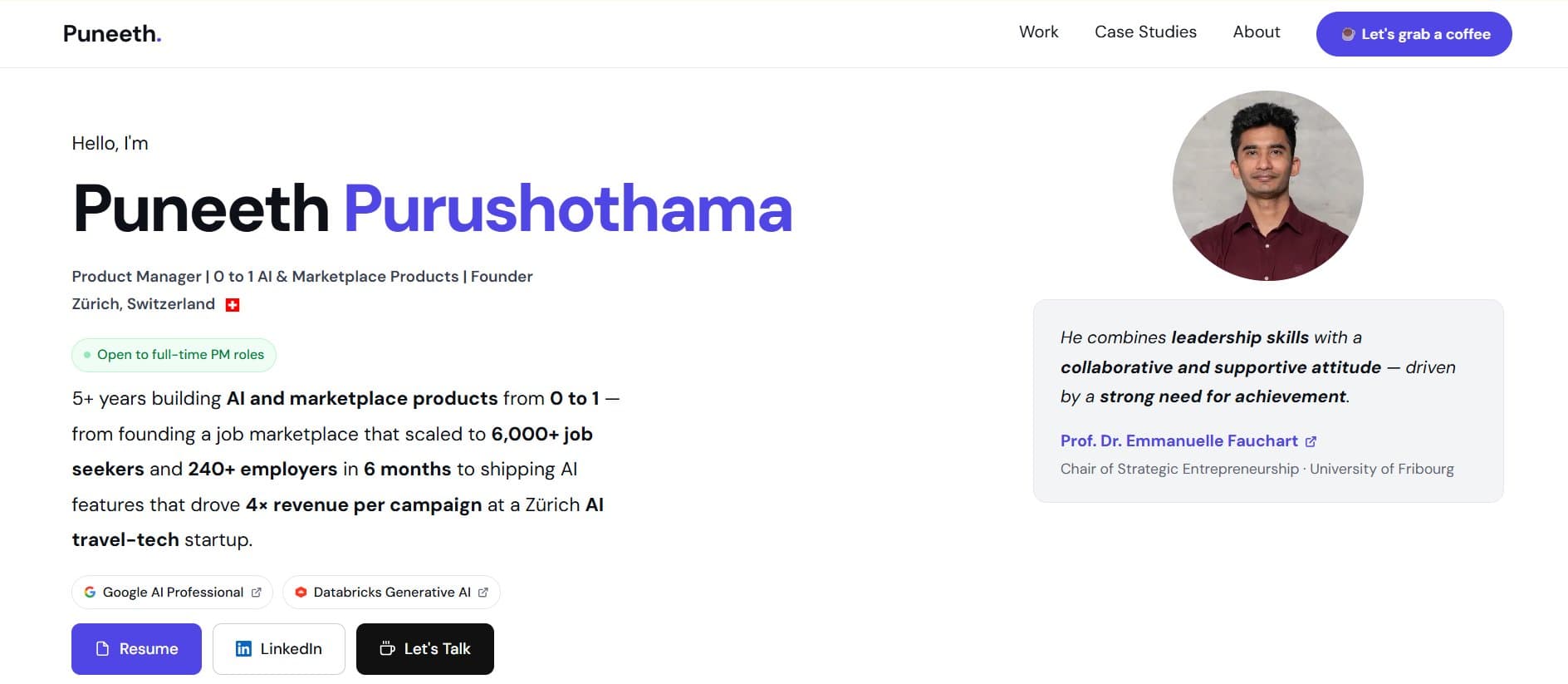
Homepage - Shipped
One page, one night. Homepage done by end of session - working, looking exactly how I wanted. First thing shipped.
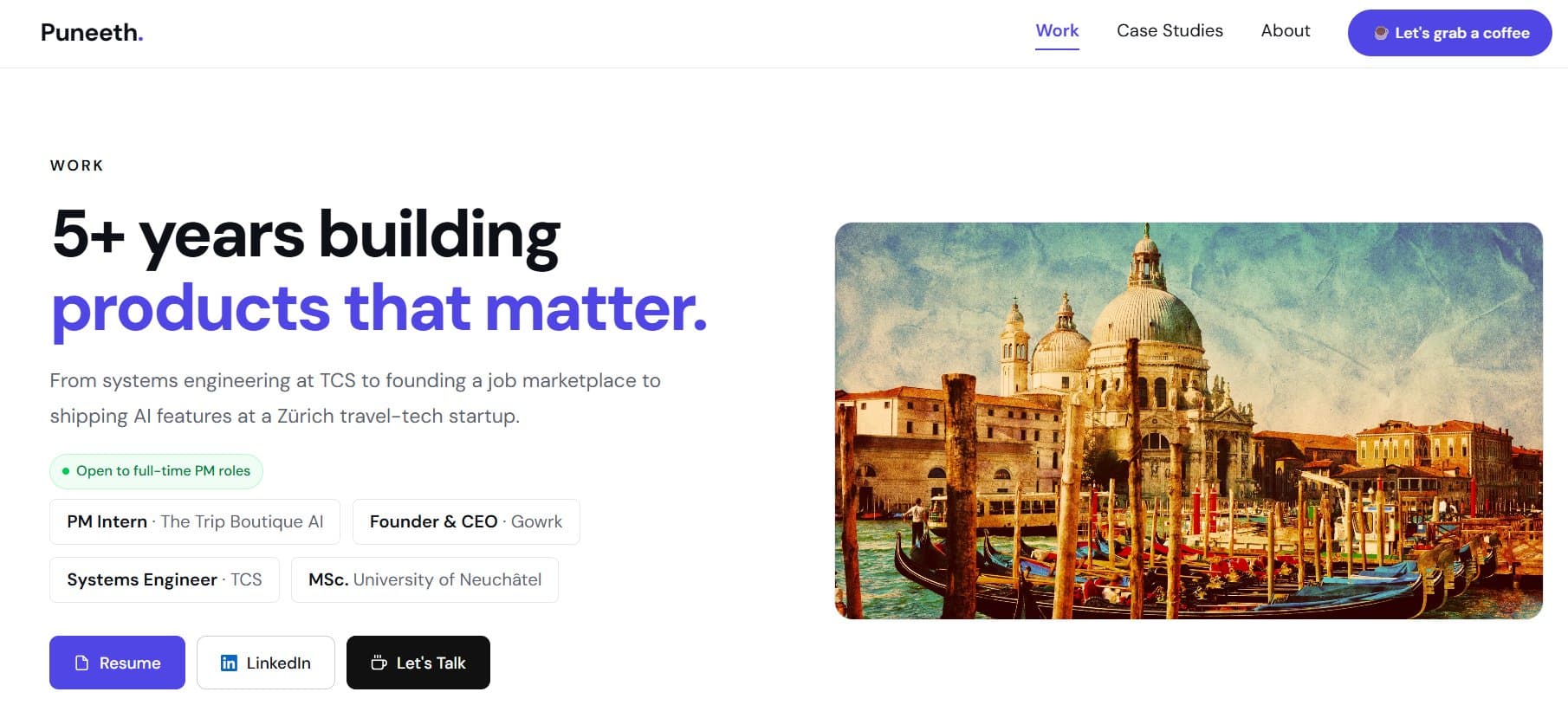
Work Page + Coffee Page
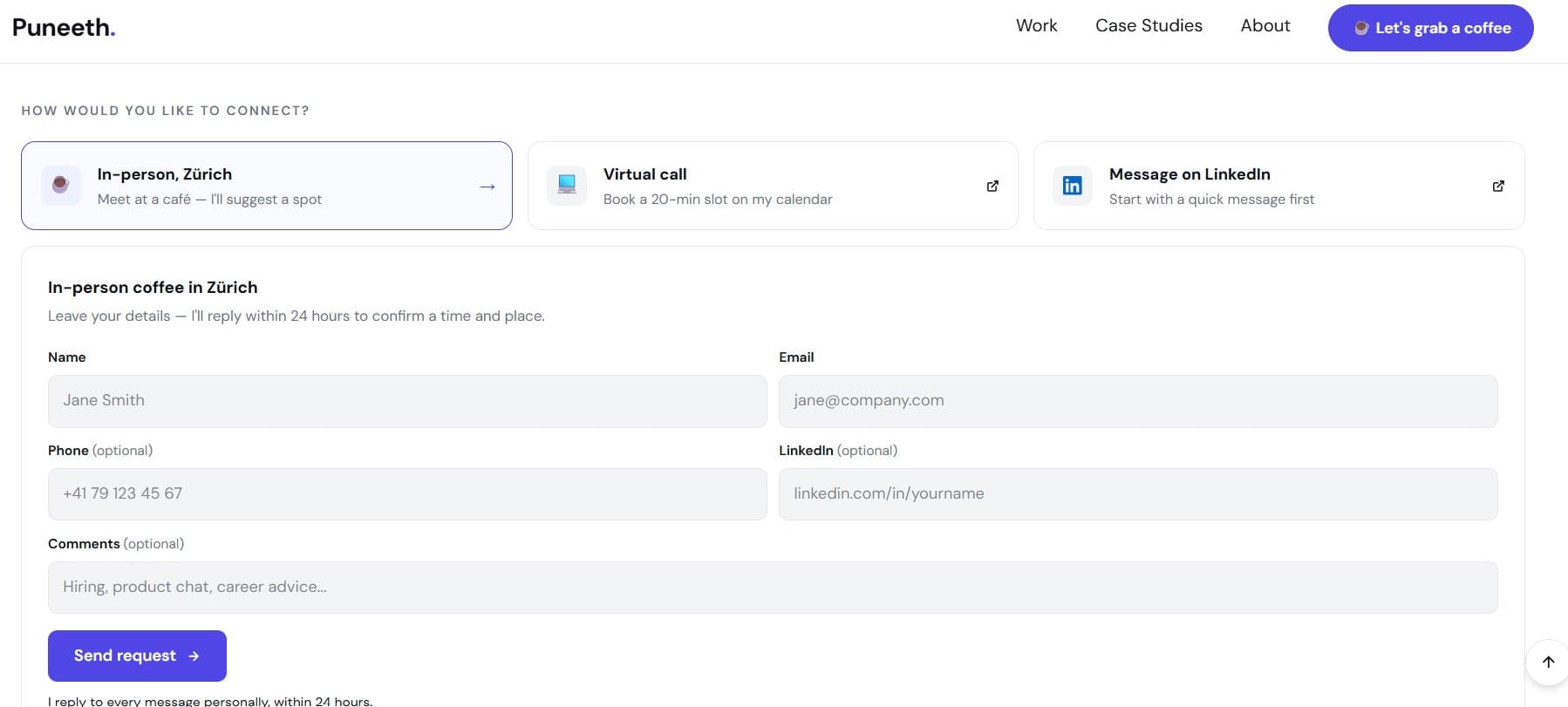
The two most important pages after the homepage. The Work page - where my case studies live. And the Coffee page - the whole point of the site. Cal.com booking integration, reminder email automation, post-booking redirect back to my work page. AI built the flow. I designed every decision about what it should do.
About Page + Privacy Page
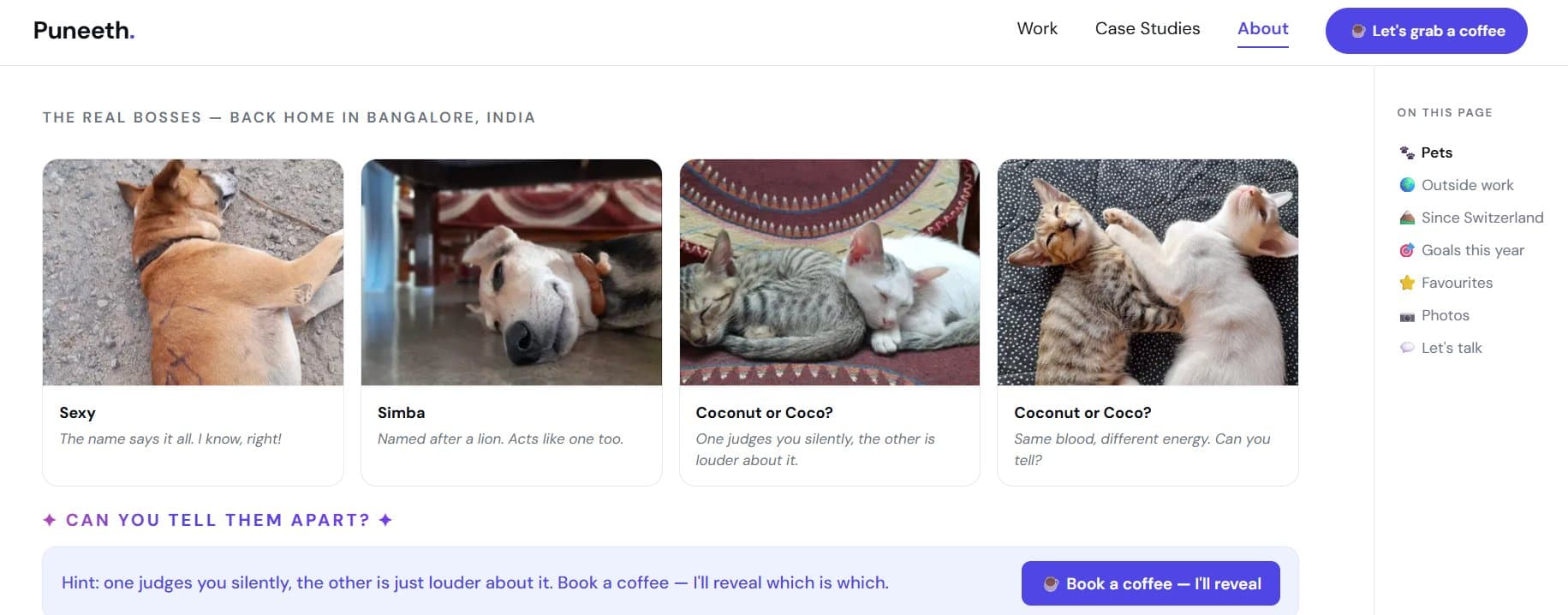
The hardest page to write is always the one about yourself. Bento card layout, personality, the cat game CTA. Then the Privacy page - unglamorous but necessary.
Bringing It All Together
Each page existed separately. Night 5 was about merging everything into one cohesive site - and making sure it worked everywhere. Desktop, mobile, tablet. The kind of work nobody sees but everyone notices when it's wrong.
Hosting, SEO, Bug Fixes - Ready to Launch
Hosting set up. Sitemap.xml submitted to Google Search Console - 4 pages indexed. Bugs squashed, including a Safari rendering issue resolved in three Claude Code exchanges. Six nights. Zero React experience. One portfolio ready to get coffee meetings.
The Real Story
What Actually Failed
The night-by-night timeline makes it look linear. It wasn't.
The Sidebar Problem - Fix One, Break Two
Every time I fixed the sidebar on one page, it broke on another. Shared state across components - took parts of two nights to resolve.
Everything Iterated - Multiple Times
No page shipped on the first draft. The coffee page was rebuilt entirely - too much friction in the original flow. Vibe coding is fast, but fast means you can afford to iterate. Not that you won't need to.
What I'd Prioritise Differently
Build the shell first. I built pages in isolation and paid for it on Night 5. Next time: basic nav structure on Night 1, then add pages into it.
The Verdict
The Good
- Immediate feedback. You see the result instantly. Something looks wrong - fix it on the spot. No waiting 3 days for a revision. You stay in flow.
- Work at your own speed. One page per night. One feature at a time. Nobody blocking you, you're not blocking anyone.
- You get better as you go. Night 1 is the hardest. By Night 6 you're moving fast and the output is sharper. Vibe coding is a skill. You build it by doing it.
The Bad
- Change one thing, it changes everything. Ask Claude Code to tweak a colour and suddenly the layout shifts. Be surgical with your prompts - ask for exactly what you want, nothing more.
- Generic prompts, generic output. “Make it look better” is not a prompt. “Make the headline larger, remove the shadow, increase spacing between sections” - that's a prompt.
The Ugly
- Tokens expire fast when applying changes across multiple pages at once. Use other LLMs to format your changes to be clear, precise, and ready to execute before you start the session.
The Numbers
Results
The Stack
Tech Stack
| Category | Tool |
|---|---|
| LLM | Claude Sonnet 4.6 (Anthropic) |
| Framework | Next.js (React) |
| Deployment | Vercel |
| Booking | Cal.com |
| SEO | Google Search Console |
| Concept | Vibe Coding (coined by Andrej Karpathy, Feb 2025) |
What I Would Do Again
My Best Practices
Know your outcome before you open Claude Code
I knew I wanted coffee meetings. Every decision flowed from that. Vague goals produce vague output.
One page per session
Complete it, test it, move on. Keeps momentum high and makes the integration night manageable.
Launch is not finishing - budget for iteration
The site you ship is v1, not the final version. Plan for at least a few sessions post-launch.
Use a different AI to rate your site
Ask it to act as a hiring manager with 10 seconds on your portfolio. The feedback is brutal, specific, and free.
Ask AI to apply best practices
SEO, accessibility, mobile, conversion - one review session after launch meaningfully improved the result.
Post-Launch Thinking
What I Expect to Learn After Launch
The site just launched. Which means I have hypotheses - not answers yet. Here's what I'll be watching.
Will people actually click the coffee CTA?
The whole site is built around one conversion. If people leave without clicking, the funnel has a leak - and each drop-off point tells a different story.
What do hiring managers mention first in meetings?
Whatever they reference unprompted - case studies, cat game, certifications - is what actually made them book. That's what I double down on.
Does the case study itself drive meetings?
Posted on launch day. My hypothesis: readers are more likely to book than casual visitors - they've already spent 5 minutes with my thinking.
I built this site to get coffee meetings. I don't know if it will work. But I know that having a clear goal, a specific user, and a way to measure success puts me in a much better position than most people who build portfolios just to “have one.” Launch is the start of the experiment - not the end of it.
The Takeaway
Conclusion
AI executes on your thinking - but you need to think first
Clear outcome = rocket ship. Vague outcome = circles.
AI gets you from 0 to 80%. The last 20% is yours.
Your domain knowledge, your taste, your judgment. That's your edge - protect it, never outsource it.
Coding as the barrier to entry will become obsolete
Thinking, taste, and domain expertise won't. Know what to build. Describe it precisely. AI handles the rest.
6 nights. No developer. No template. No React experience.
Just clarity and Claude Code. If you have something worth building - the barrier is gone. Start tonight.
The last 20% is where you live. AI handles the rest. That 20% is your edge - protect it, develop it, never outsource it.
- The real lesson from 6 nights of vibe coding
Want to talk products?
AI tools, marketplace building, job searching in Europe - 30 minutes, no agenda.
Get in touch →Or just look around first - puneethp.comReferences
- Karpathy, A. (February 2025). “Vibe coding” - coined via post on X (formerly Twitter). x.com/karpathy
- Wikipedia. (2025). Vibe coding. en.wikipedia.org/wiki/Vibe_coding
- Collins Dictionary. (2025). Word of the Year 2025: Vibe Coding. collinsdictionary.com/woty
- Vercel. (2025). What You Need to Know About Vibe Coding - 63% of vibe coding users are non-developers. vercel.com/blog/what-you-need-to-know-about-vibe-coding
- DemandSage. (2025). 47 LinkedIn Statistics 2026. 1.3B members, 310M monthly active users. demandsage.com/linkedin-statistics
- Ladders. (2024). You Only Get 6 Seconds of Fame - Make It Count. Eye-tracking study on recruiter resume behaviour. theladders.com
- Glassdoor. (2024). 50 HR & Recruiting Stats That Make You Think. Average number of applications per job posting: 250+. glassdoor.com/blog
- Hover. (2024). The Importance of an Online Portfolio Site. 86% of employers visit a portfolio site if linked in an application. hover.blog/online-portfolio-site-importance
- Texas State University Career Services. (2025). Portfolio Guide - Filtering Materials & Proving Skills. careerservices.txst.edu
- Cover image: Vibe Coding - generated by Google Gemini Nano. Used for illustrative purposes.